
The US Federal Reserve's interest rate decision is the biggest event that would drive sentiments in the domestic stock market this week, besides a host of macroeconomic data from the global front and trading activity of foreign investors, analysts said. The Indian equity market had an exceptional last week, with both the Nifty and Sensex hitting their all-time high levels on Thursday.

For all its claims to economic glory, the majority of India's population lives vulnerable lives, a situation that has only worsened over the past 15 years, to the extent that the government now fears to release economic data or even conduct a proper Census, notes Rathin Roy.

The report said that "we believe, institutions are more important than individuals" and ultimately what is important is the credibility and the independence of any institution and nothing else.
Many analysts over the past week have said the RBI has legroom to cut rates to the tune of 65 bps by June and some like Barclays and BofA have also spoken about the likelihood of an inter-meeting cut.

RBI may revise remuneration for banks.

RBI also retained its GDP growth forecast at 7.6 per cent

Concerned over elevated inflation, Reserve Bank of India on Friday decided to leave the benchmark interest rate unchanged at 4 per cent but maintained an accommodative stance, implying more rate cuts in the future if need arises to support the economy hit by the Covid-19 pandemic.
Growth impulses, while improving, remain fragile, and a rate hike will be disruptive to interest costs.

India's economic growth will be above 6 per cent in the current fiscal as the country has managed to strengthen its macroeconomic stability and performance even in a period of large global shocks, RBI Monetary Policy Committee (MPC) Member Ashima Goyal said on Monday. Goyal further said that a global slowdown reducing India's export growth, geopolitics fueling oil and food prices, and erratic weather are some of the continuing risks that the country faces. "India has managed to strengthen its macroeconomic stability and performance even in a period of large global shocks.

The wholesale price-based inflation rose for the second consecutive month in February to 4.17 per cent, as food, fuel and power prices spiked. The WPI inflation was 2.03 per cent in January and 2.26 per cent in February last year. After witnessing months of softening of prices, the food articles in February saw 1.36 per cent inflation. In January it was (-) 2.80 per cent.

Reserve Bank of India Governor Shaktikanta Das tells Anup Roy, Raghu Mohan and Niraj Bhatt that it is time for banks to lower interest rates and start lending to cash-starved finance companies after due credit appraisal and proper risk assessment.

RBI wants periodic revision of the pensions for its retired employees.
Higher for longer' may be the narrative in the developed markets, but interest rates might not stay high for very long in India, with a section of the market expecting rate cuts to begin this year. The six-member Monetary Policy Committee of Reserve Bank of India (RBI) decided to keep interest rates unchanged at 6.5 per cent in the April review - after hiking the policy repo rate in six previous meetings. RBI Governor Shaktikanta Das emphasised that the pause was only for the April policy and that the central bank was ready to act if the situation demanded.

A likely easing in inflationary pressures in the forthcoming months will reopen the window for the RBI to once again prioritise growth and ease its interest rates.

The Reserve Bank of India (RBI) on Wednesday announced an extension of interim ways and means advances (WMAs) limit of Rs 51,560 crore to state governments till September, to help them tide over the financial stress posed by the second wave of COVID-19. WMAs are temporary advances given by the RBI to the states to tide over any mismatch in receipts and payments. There are two types of WMA - normal and special. While normal WMA are clean advances, special WMA are secured advances provided against the pledge of the government of India dated securities.

The Reserve Bank of India (RBI) on Friday decided to leave the benchmark interest rate unchanged at 4 per cent but maintained an accommodative stance, implying rate cuts in the future if need arises to support the economy hit by the Covid-19 pandemic.

The US Federal Reserve's interest rate decision, global market trends and trading activity of foreign investors are the major factors that would dictate terms in the equity markets in a holiday-shortened week ahead, analysts said. Equity markets will remain closed on Tuesday on account of Ganesh Chaturthi. From the global front, interest rate decisions from the Bank of England and Bank of Japan would also influence market trends.

The Reserve Bank on Friday retained the GDP forecast for the current financial year at 9.5 per cent and flagged global semiconductor shortages, elevated commodity prices and potential global financial market volatility as downside risks to economic growth. In his address after the three-day meeting of the rate-setting panel, RBI Governor Shaktikanta Das said recovery in aggregate demand gathered pace in August-September, and it is reflected in high-frequency indicators, like railway freight traffic; port cargo; cement production; electricity demand; e-way bills; GST and toll collections. "The ebbing of infections, together with improving consumer confidence, has been supporting private consumption," he said, and added the pent-up demand and the festival season should give further fillip to urban demand in the second half of the financial year.

Elevated food price-led inflation could become a sore point for markets, which they seem to be ignoring at current levels, observe analysts. Retail inflation in India - as measured by the Consumer Price Index (CPI) - came in at a three-month high of 6.52 per cent in January 2023, compared with 5.72 per cent in December and 5.88 per cent in November 2022. The inflation print for February, according to Madan Sabnavis, chief economist at Bank of Baroda, will be critical for the Reserve Bank of India's monetary policy committee.

The S&P BSE Midcap and the S&P BSE Smallcap indices added 0.5% and 0.7%, respectively

The Indian equity market is likely to remain under pressure and rangebound over the next few months. This comes as global central banks, led by the US Federal Reserve look at a possibility of hiking rates aggressively to tame inflation. Back home, the Reserve Bank of India, too, remains data dependent in its endeavour to keep inflation in check and pursue an aggressive monetary policy stance.

Rupee ends flat against dollar ahead of Fed policy outcome.

Amendments to RBI Act likely soon

RBI is expected to discuss about the impact of GST in its monetary policy.

The Index of Industrial Production (IIP) grew by 1.4 per cent in November as most components like manufacturing, electricity, mining, primary goods, and consumer durables witnessed a slowdown, according to data released by the National Statistical Office (NSO) on Wednesday. This is on the base of a decline of 1.7 per cent in November 2020 and before the new Covid variant started impacting economic activity. IIP growth was lower than the 4 per cent expansion recorded in the previous month but was better than a 1.6 per cent contraction seen in November 2020. Separately, rising prices of kitchen staples pushed retail inflation, or rate of price increase, to 5.59 per cent in December 2021, bringing it close to the upper band of Reserve Bank's comfort zone.

In the backdrop of an over four-decade high inflation, the US Federal Open Market Committee has raised its key policy interest rate by 75 basis points to 2.25-2.50 per cent, anticipating that the increase in the interest rates will be "appropriate". Hiking interest rates typically cool demand in the economy, thereby putting a brake on the inflation rate. The US Federal Reserve in its June meeting too raised the interest rate by 75 basis points, which was the steepest hike since 1994.

investors will look to the new governor to continue the banking sector clean-up with the same urgency as Mr Rajan, who was targeting fully cleaned-up and provisioned balance sheets by March 2017

The finance ministry on Thursday raised concerns over the possible impact of El Nio conditions on India this year, saying if recent forecasts came true, the country could see lower agricultural output and higher inflation. "Some meteorological agencies predict the return of El Nio conditions in India this year. "If these predictions are accurate, then monsoon rains could be deficient, leading to lower agricultural output and higher prices," the ministry said in its monthly economic review.

Equity indices made an emphatic comeback on Friday after falling for seven straight sessions after the RBI hiked interest rates by 50 basis points on expected lines and projected inflation coming under control from January next year. A strong recovery in the rupee added to the momentum, traders said. Overcoming a wobbly start, the 30-share BSE Sensex soared 1,016.96 points or 1.80 per cent to settle at 57,426.92. During the day, it rallied 1,312.67 points or 2.32 per cent to 57,722.63.
Chances of a rate cut in April improve if core inflation continues to ease, growth falling below the projected 7.2% for FY19 and if the global trade slowdown exacerbates.
SBI is the first major bank to cut its base lending rate this year.

S&P expects India to grow at 7.4 per cent in 2015, similar to the central bank's forecast for the fiscal year ending in March.

After consumer price index jumped the 6.3-per cent mark in May and wholesale inflation set a record of 12.94 per cent, house economists at Swiss brokerage UBS Securities have warned that the country is facing more upside risks on the inflation front that is set to averaging at 5 per cent for the year. Rising prices of edible oils and protein rich items pushed retail inflation to a six-month high of 6.3 per cent in May, breaching the comfort level of the Reserve Bank and thus rendering reduction in interest rates a difficult proposition in the near term. Led by petrol price, that has crossed the Rs 100-mark in many states, wholesale inflation too accelerated to a record 12.94 per cent in May. While crude oil has crossed $70 a barrel on account of rising prices of crude oil and manufactured goods due to spike in commodities, and the low base of last year due to the lockdown.

Raghuram Rajan called for purposeful and effective action to counter the atmosphere of cynicism, which has slowed down the decision making process.
By no means do economists see the Reserve Bank of India stop at just a 25-bp cut. Some of the economists such as Soumyakanti Ghosh of State Bank of India are of the firm view that rates have room to fall by a total of 75 bps in the current financial year, starting with 25 bps in the August 7 policy.

A combination of farm loan debt waivers by state governments and the implementation of the pay commission award could entail some fiscal slippages and pose a risk to inflation

The recovery in the Indian services sector was sustained in November as new work orders supported business activity growth and the first rise in employment in nine months, a monthly survey said on Thursday.

Banks seems to be upset over RBI's move over rate cut.
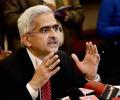
The uncertainty created by the jump in COVID-19 infections and localised lockdowns prompted RBI Governor Shaktikanta Das and other members of the rating setting panel MPC to unanimously vote for status quo in interest rates and an accommodative policy stance to support growth, as per minutes of the meeting released on Thursday. "The need of the hour is to effectively secure the economic recovery underway so that it becomes broad-based and durable," the Governor said during the three-day meeting of the Monetary Policy Committee (MPC) which ended on April 7. The renewed jump in COVID-19 infections in several parts of the country and the associated localised and regional lockdowns add uncertainty to the growth outlook, he observed, as per the minutes of the meeting released by the central bank.

The wholesale price-based inflation accelerated to a record high of 12.94 per cent in May, on rising prices of crude oil and manufactured goods. Low base effect also contributed to the spike in WPI inflation in May 2021. In May 2020, WPI inflation was at (-) 3.37 per cent. This is the fifth straight month of uptick seen in the wholesale price index (WPI)-based inflation. In April, 2021, WPI inflation hit double digit at 10.49 per cent. "The annual rate of inflation, based on monthly WPI, was 12.94 per cent for the month of May, 2021 (over May, 2020) as compared to (-) 3.37 per cent in May 2020.
 © 2026 Rediff.com - Advertise with us - Disclaimer - Privacy Policy - Sitemap - Feedback - About us - Terms of use - Grievances